


1. What is Mechanics?

Mechanics is the branch of physical science that describes and predicts the conditions of rest or motion of bodies subjected to the action of forces. As one of the oldest physical sciences, it serves as the scientific foundation for major engineering disciplines, particularly civil, mechanical, and structural engineering. Its primary role in engineering is to predict physical phenomena, providing the critical mathematical formulas and physical principles needed to evaluate whether structures can support their intended loads safely.
2. Branches of Mechanics
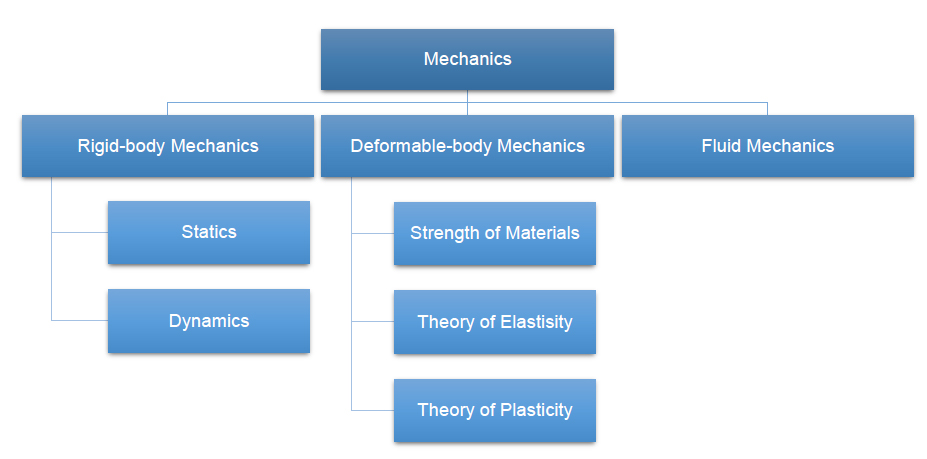
Engineering mechanics is divided into three main branches to simplify calculations and accommodate different physical assumptions:
- Rigid-Body Mechanics: Assumes that the solid object is perfectly rigid and undergoes zero shape change under any load. It is subdivided into Statics (forces on bodies at rest or moving with constant velocity) and Dynamics (accelerating bodies).
- Deformable-Body Mechanics: Investigates the internal stress, strain, and shape change of actual structures under external forces, forming the basis for Mechanics of Materials.
- Fluid Mechanics: Studies the behavior of incompressible fluids (like water in hydraulics) and compressible fluids (like gases).
3. Rigid Bodies vs. Deformable Bodies
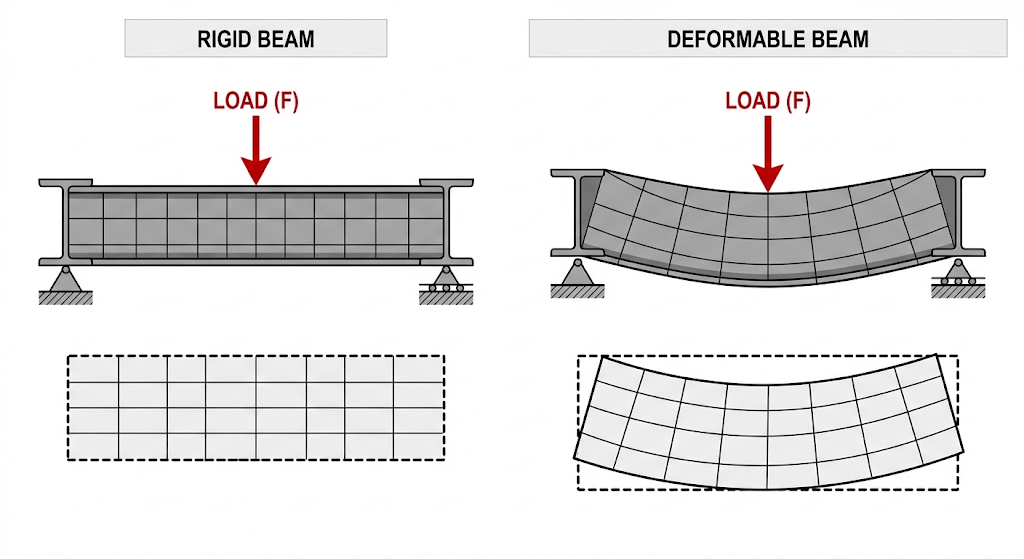
The distinction between rigid and deformable bodies represents the transition from global equilibrium analysis in Statics to localized structural safety in Mechanics of Materials. While Statics treats objects as infinitely stiff to simplify reaction force calculations, Mechanics of Materials acknowledges physical deformability to prevent structural failure. The key differences are summarized below:
| Feature / Assumption | Rigid Body | Deformable Body |
|---|---|---|
| Relative Particle Distance | Remains perfectly fixed before and after loading | Changes relative positions under loading |
| Material Influence | Ignored (material type does not affect forces) | Crucial (elastic modulus, Poisson's ratio, etc. are used) |
| Primary Fields | Statics and Dynamics | Mechanics of Materials & Theory of Elasticity |
| Primary Focus | External forces, supports, global equilibrium | Internal forces, stresses, strains, safety, and failure |
4. What is Strength of Materials?
Strength of Materials (or Mechanics of Materials) is a core discipline of deformable-body mechanics that examines the relationships between external forces applied to a body and the internal effects, stresses, and strains generated within the material. Instead of analyzing bodies as abstract rigid objects, it examines real-world materials that deform under loads. Key concepts in this field include:
- Deformation: The physical change in size and shape of a solid body when external loadings are applied.
- Internal Forces: The internal resistance forces (such as normal force, shear force, and bending moments) generated within the material to balance external loads.
- Stress (\(\sigma\) or \(\tau\)): The intensity of these internal forces distributed over a specific cross-sectional area (force per unit area).
- Strain (\(\epsilon\) or \(\gamma\)): The geometric measure of deformation, expressing length or angular changes per unit of original geometry.
5. Types of Problems in Mechanics of Materials
Engineers solve two fundamental types of problems in Mechanics of Materials to ensure the structural integrity of machines and civil infrastructures:
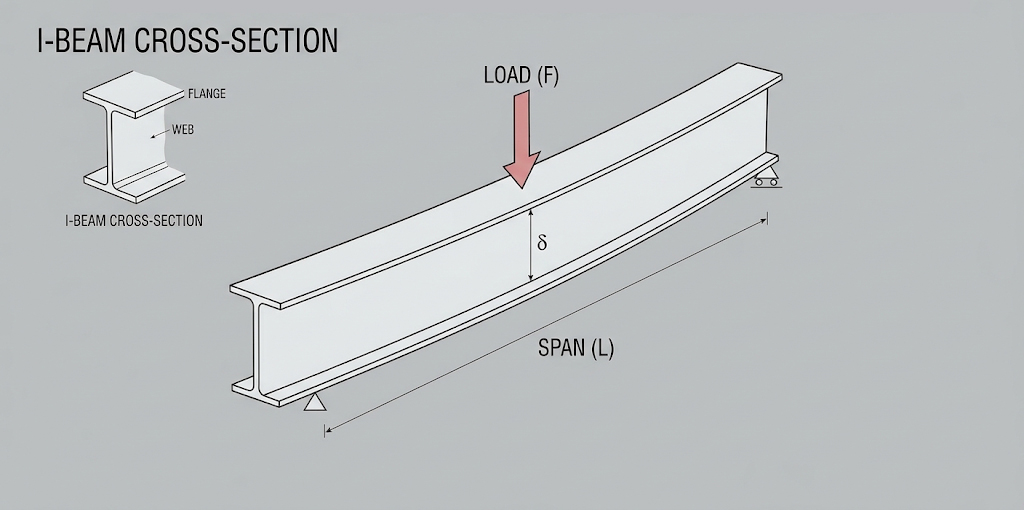
- Analysis Problems (Safety Checks): In analysis, the material properties, member dimensions, and applied loads are completely known. The engineer's goal is to determine whether the existing design is safe by performing a "stress check", verifying that the maximum stress does not exceed the material's allowable limit:
\(\sigma_{max} \le \sigma_{allow}\)
- Design Problems: In design, the applied external loads and allowable stresses are known. The goal is to determine the required geometric dimensions (such as cross-sectional area or profile type) of a structural member so that it carries the loads safely and economically:
\(A_{req} = \frac{P}{\sigma_{allow}}\)
To account for uncertainties in loading, material variability, environmental deterioration, and analysis approximations, engineers utilize a Factor of Safety (F.S.) greater than 1.0 to bridge the gap between experimental failure stress and safe working stress:
\(F.S. = \frac{\sigma_{fail}}{\sigma_{allow}}\)