

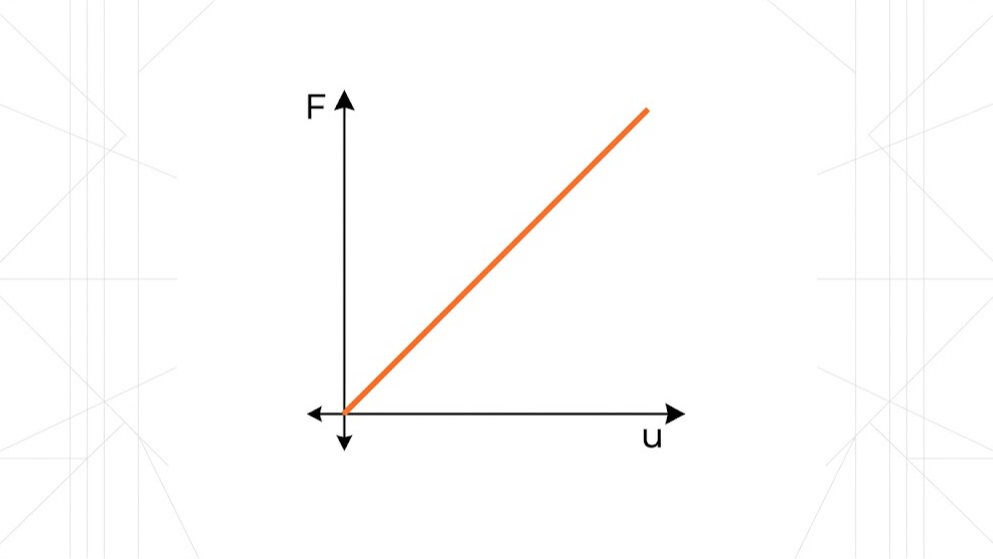
1. Elastic and Plastic Materials
In the study of deformable bodies, the behavior of materials under external loads is classified based on their ability to recover their original shape upon unloading. Materials can be broadly classified into two ideal categories:
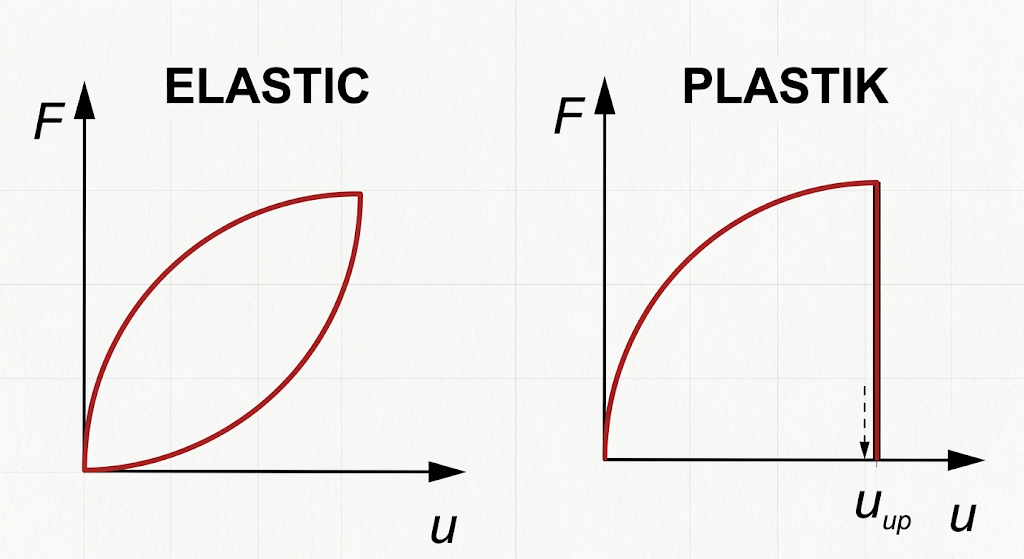
- Elastic Material: An ideal elastic material experiences deformation only while subjected to external loads. As soon as the loads are completely removed, all strains within the body disappear, and it returns to its original undeformed geometry.
- Plastic Material: An ideal plastic material undergoes permanent dimensional changes under loading. When the external forces are removed, the material does not return to its original shape; instead, a permanent strain (plastic strain, \(\epsilon_{pl}\)) remains.
The transition between these behaviors is called elastic deformation (which is temporary and fully recoverable) and plastic deformation (which is permanent and unrecoverable).
2. Elastic–Plastic Material
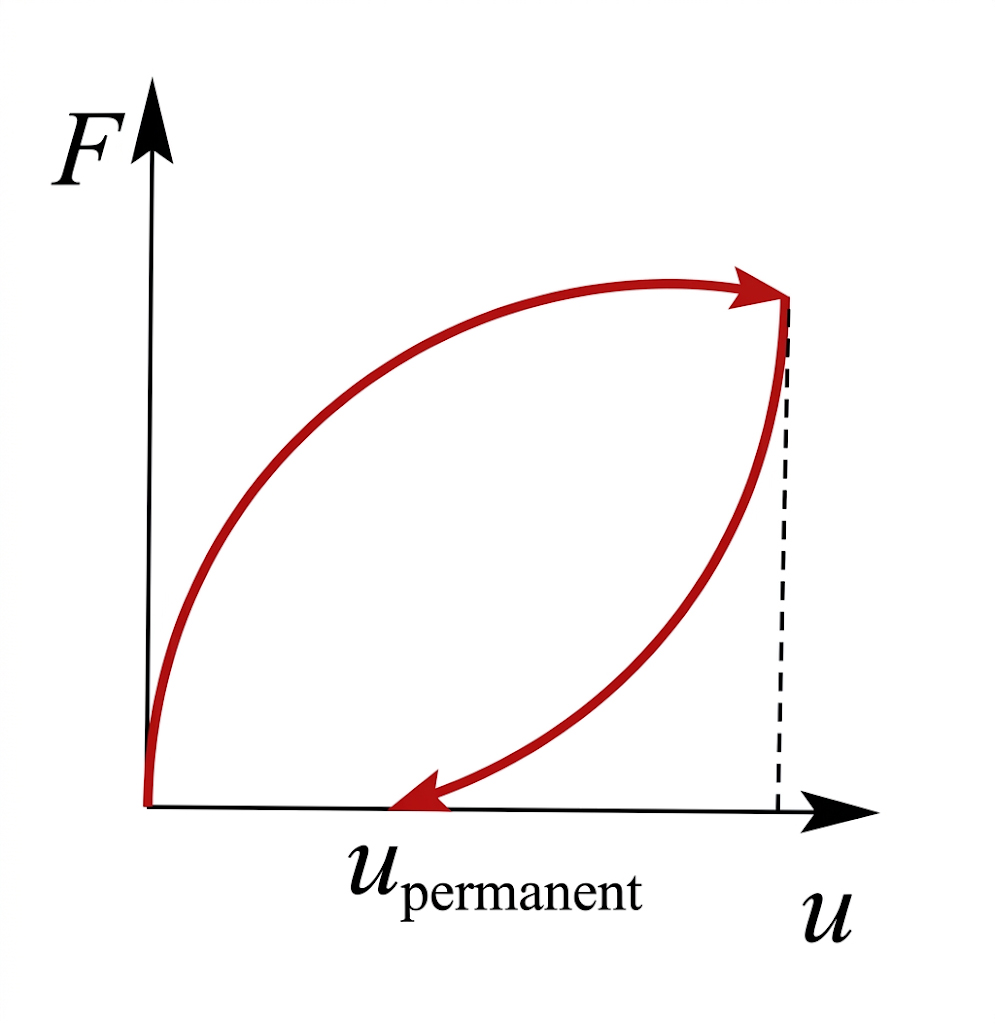
Most real engineering materials, such as structural steel and copper, exhibit a combination of both elastic and plastic properties depending on the intensity of the applied loads. These are referred to as elastic-plastic (or elastoplastic) materials.
Under low loading levels, the material behaves elastically. However, as the load is gradually increased, the internal stresses eventually reach a critical threshold called the yield stress (\(\sigma_Y\)). Once the stress exceeds this yield point, the material enters the plastic range and begins to yield, experiencing large permanent deformations with little or no additional load. When the load is removed from an elastic-plastic material that has yielded, the unloading path follows a straight line parallel to the initial elastic curve, recovering only the elastic portion of the strain and leaving a permanent set (plastic deformation).
3. Linear Elastic Material
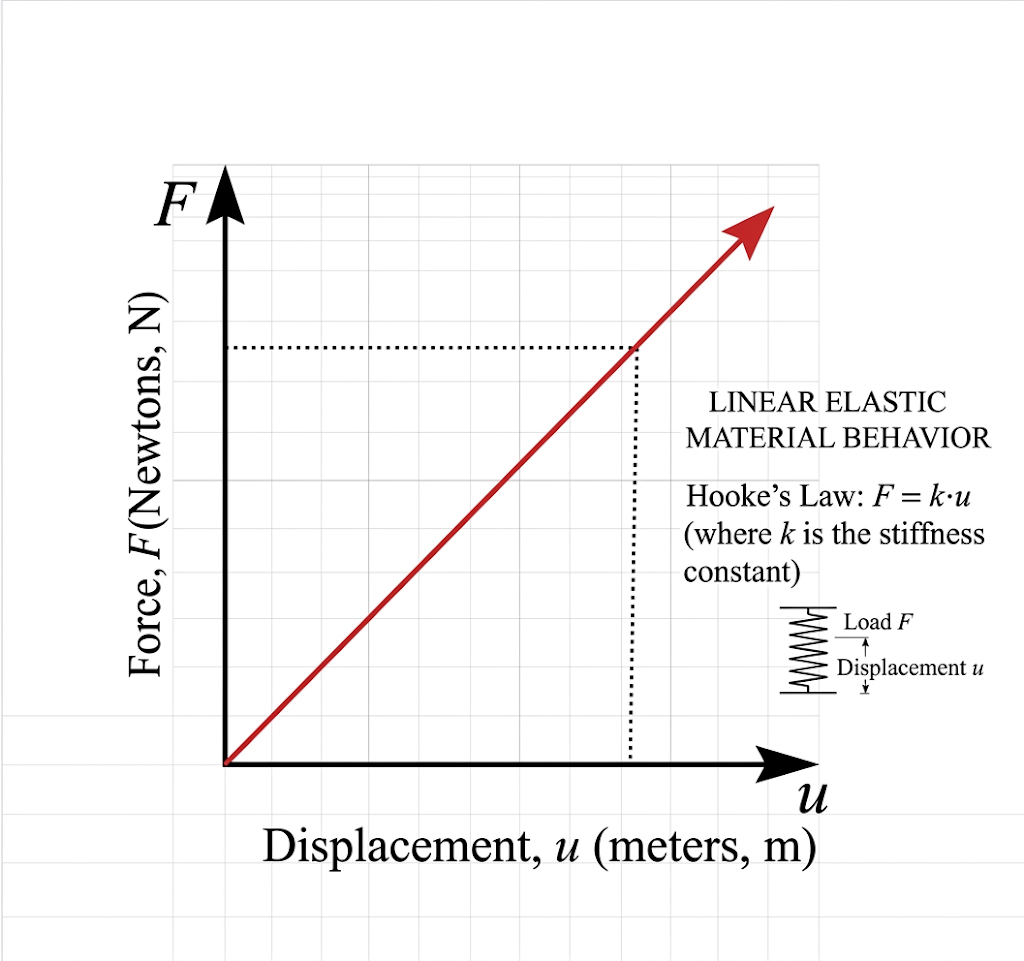
A material is described as linear elastic if the stress developed within it is directly proportional to the strain throughout the elastic region. This proportional relationship is known as Hooke's Law, which states that force is proportional to displacement, with the constant of proportionality being mechanical stiffness of the material — its capacity to resist elastic deformation under load.
It is crucial to emphasize that Hooke's law is valid only when the material behaves in a linear elastic manner. If the material does not exhibit linear elastic behavior, this proportional relationship ceases to exist, making Hooke's law invalid.
A common student misconception is that "elastic" and "linear elastic" are synonymous. They are not! Elasticity simply means the material returns to its original shape when unloaded. A material can exhibit nonlinear elastic behavior—for example, polymers and rubber return to their original shape after unloading, but their loading/unloading path is a curved line rather than a straight line. In classical Mechanics of Materials, we assume linear elasticity to maintain mathematical simplicity.
4. Homogeneous Material
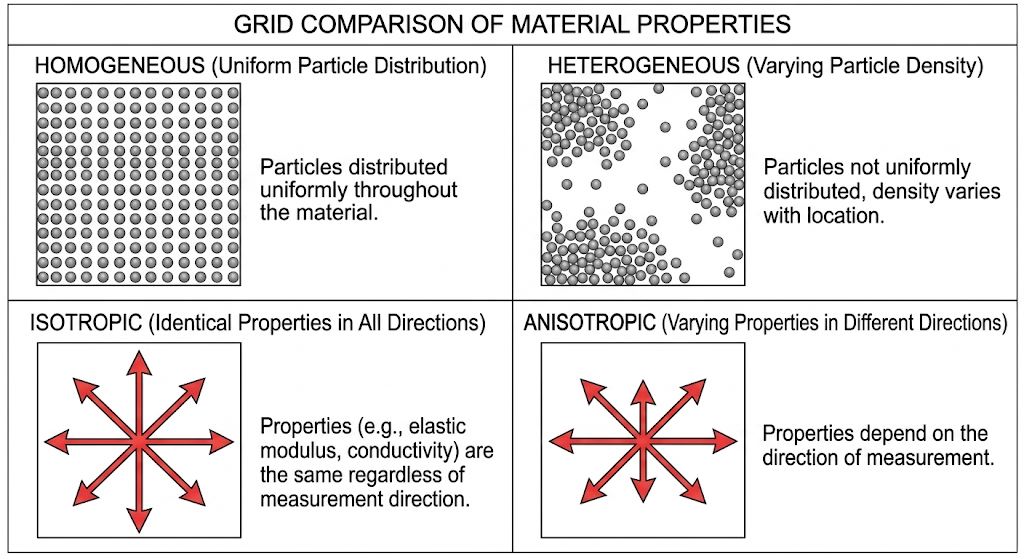
A material is defined as homogeneous if it possesses identical physical and mechanical properties at all points throughout its entire volume. In a homogeneous structural member, the material's composition is completely uniform. Mathematically, this means that material constants are independent of location.
In contrast, a heterogeneous (or non-homogeneous) material has properties that vary from one point to another. Examples of heterogeneous materials include concrete (a mixture of cement, sand, and large stone aggregates) and functionally graded materials where properties are engineered to vary continuously across the thickness.
5. Isotropic Material
A material is defined as isotropic if its physical and mechanical properties are independent of direction at any given point. If an isotropic material is loaded in tension along different directions (e.g., along the longitudinal, transverse, or vertical axes), it will exhibit the exact same stiffness and strength.
Conversely, an anisotropic material displays mechanical properties that depend strictly on the direction of loading. Anisotropic materials have different moduli of elasticity along different axes. A classic example is wood, which has a fibrous structure; its stiffness and strength along the grain are significantly higher than perpendicular to the grain. Fiber-reinforced composite laminates are also engineered anisotropic (or orthotropic) materials because their fibers are aligned to withstand forces in specific directions.
6. Homogeneous Isotropic Material
When the concepts of homogeneity and isotropy are combined, we define a homogeneous isotropic material. This idealized material has mechanical properties that are uniform throughout its entire volume (homogeneous) and are identical in all directions at any given point (isotropic).
In classical Mechanics of Materials, the vast majority of analytical derivations and structural formulas (such as beam bending, torsion, and axial deformation equations) are based on the assumption of a homogeneous, isotropic, and linear elastic material. Under these assumptions, the material's mechanical response can be fully characterized using only three standard constants namely Young's Modulus (\(E\)), Shear Modulus (\(G\)) and Poisson's Ratio (\(\nu\)).
7. Important Conceptual Distinctions
To avoid confusion, students should carefully distinguish between the four fundamental terms used to describe material idealizations. These terms describe entirely independent characteristics and can coexist in a single material:
| Concept | Physical Definition | Core Focus |
|---|---|---|
| Elasticity | The ability to fully regain original dimensions after unloading. | Shape Recovery (vs. Permanent Plasticity) |
| Linearity | The direct proportionality between force and dispalcement | Proportionality of response (obeying Hooke's Law) |
| Homogeneity | Properties are identical at every location in the body. | Location Independence (vs. Heterogeneous variance) |
| Isotropy | Properties are identical in all directions at a single point. | Direction Independence (vs. Anisotropic fibers) |
A structural element can be all four simultaneously. For example, a mild steel rod operating within its working load limits behaves as a homogeneous, isotropic, linear elastic material. Each of these descriptors addresses a different question: Will it return to its shape? (Elastic) Is the curve straight? (Linear) Is it uniform throughout? (Homogeneous) Is it identical in all directions? (Isotropic)