
1. SI Base and Derived Units
In structural engineering and mechanics of materials, physical quantities are expressed using the International System of Units (SI). These units are divided into two main categories: base units (which are physically independent) and derived units (which are mathematically constructed from the base units):
- SI Base Units: The primary independent physical quantities used in mechanics are:
- Length: measured in meters (\(\mathrm{m}\))
- Mass: measured in kilograms (\(\mathrm{kg}\))
- Time: measured in seconds (\(\mathrm{s}\))
- SI Derived Units: Quantities like force and pressure are derived using Newton's second law of motion (\(F = ma\)):
- Newton (\(\mathrm{N}\)): The SI unit of force. One Newton is defined as the force required to accelerate a mass of one kilogram at a rate of one meter per second squared:
\(1\mathrm{ N} = 1\mathrm{ kg}\cdot\mathrm{m/s}^2\)
- Pascal (\(\mathrm{Pa}\)): The SI unit of stress or pressure, defined as a force of one Newton distributed uniformly over an area of one square meter:
\(1\mathrm{ Pa} = 1\mathrm{ N/m}^2\)
- Newton (\(\mathrm{N}\)): The SI unit of force. One Newton is defined as the force required to accelerate a mass of one kilogram at a rate of one meter per second squared:
2. Large and Small Quantities
Engineering structures operate across vastly different physical scales. For instance, the diameter of a steel reinforcing bar might be a small fraction of a meter, whereas the internal forces resisting a bridge load can reach millions of Newtons. To write and manipulate these very large or very small numbers efficiently without excessive zeros, engineers utilize two standard formatting methods:
- Scientific Notation: Represents numbers as a product of a decimal number (between 1 and 10) and a power of ten (e.g., \(3.5 \times 10^6\) or \(2.5 \times 10^{-6}\)).
- Prefix Notation: Replaces powers of ten with standardized abbreviations to make technical writing and oral communication much cleaner.
3. SI Prefixes
To keep calculations readable, we attach prefix symbols to standard SI units. In the study of Mechanics of Materials, we almost exclusively use prefixes that represent multiples of thousands (\(10^3\), \(10^6\), \(10^9\)) or thousandths (\(10^{-3}\), \(10^{-6}\), \(10^{-9}\)). The most frequently used prefixes are summarized in the table below:
| Prefix | Symbol | Factor (Power of 10) |
|---|---|---|
| giga | G | \(10^9\) (one billion) |
| mega | M | \(10^6\) (one million) |
| kilo | k | \(10^3\) (one thousand) |
| milli | m | \(10^{-3}\) (one thousandth) |
| micro | \(\mu\) | \(10^{-6}\) (one millionth) |
| nano | n | \(10^{-9}\) (one billionth) |
4. Unit Conversion
Converting units accurately is one of the most critical practical skills in structural engineering. A single decimal placement error can lead to a catastrophic design failure. Below are the basic conversion principles that must be memorized:
- Force Conversions:
\(1\mathrm{ kN} = 10^3\mathrm{ N} = 1000\mathrm{ N}\) - Stress Conversions:
\(1\mathrm{ MPa} = 10^6\mathrm{ Pa}\)
\(1\mathrm{ GPa} = 10^9\mathrm{ Pa} = 10^3\mathrm{ MPa}\) - Length Conversions:
\(1\mathrm{ m} = 1000\mathrm{ mm} \rightarrow 1\mathrm{ mm} = 10^{-3}\mathrm{ m}\)
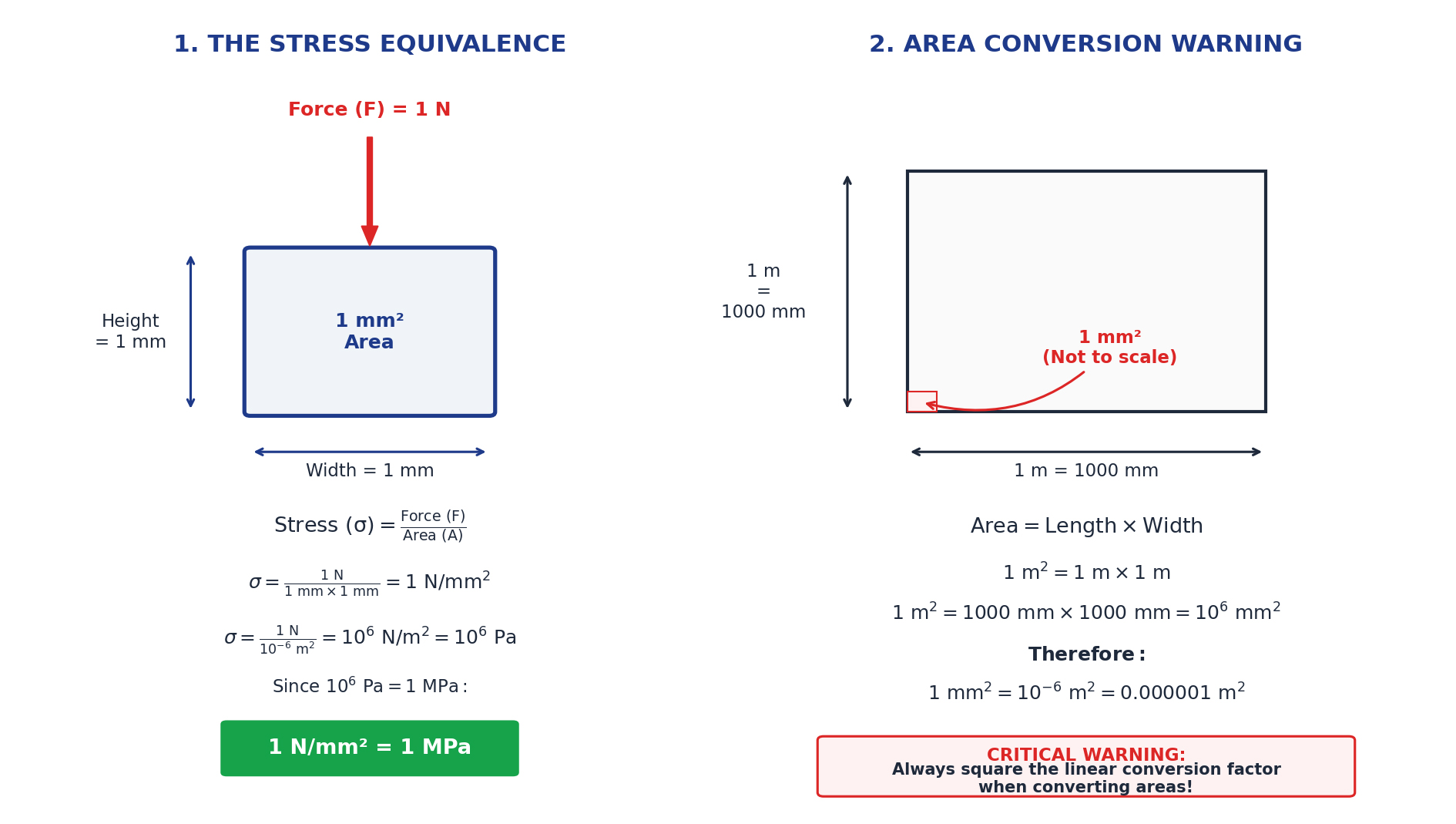
A very common student mistake is applying linear conversion factors directly to areas or volumes. When converting areas or volumes, you must square or cube the linear conversion factor:
Area: Since \(1\mathrm{ m} = 10^3\mathrm{ mm}\), then:
\(1\mathrm{ m}^2 = (10^3\mathrm{ mm})^2 = 10^6\mathrm{ mm}^2\)
\(1\mathrm{ mm}^2 = (10^{-3}\mathrm{ m})^2 = 10^{-6}\mathrm{ m}^2\)
Volume:
\(1\mathrm{ m}^3 = (10^3\mathrm{ mm})^3 = 10^9\mathrm{ mm}^3\)
\(1\mathrm{ mm}^3 = (10^{-3}\mathrm{ m})^3 = 10^{-9}\mathrm{ m}^3\)
5. Engineering Notation
While scientific notation allows any power of ten, engineering notation strictly restricts the exponents of ten to multiples of three (i.e., ..., \(-9\), \(-6\), \(-3\), \(0\), \(3\), \(6\), \(9\), ...). This direct restriction matches standard physical prefixes (kilo, mega, milli, micro, etc.), making numbers immediately translatable into physical terms.
Let us look at a comparison of how the same numbers are represented under both notation styles:
- Very Small Number (0.0000025):
- Scientific Notation: \(2.5 \times 10^{-6}\)
- Engineering Notation: \(2.5 \times 10^{-6}\) (equivalent here since \(-6\) is a multiple of \(3\)). This is read as \(2.5\ \mu\mathrm{m}\) or \(2.5\) micro-units.
- Large Number (3500000):
- Scientific Notation: \(3.5 \times 10^6\)
- Engineering Notation: \(3.5 \times 10^6\) (read directly as \(3.5\mathrm{ M}\) or \(3.5\) mega-units).
- Number (470000):
- Scientific Notation: \(4.7 \times 10^5\) (not directly corresponding to any standard prefix).
- Engineering Notation: \(470 \times 10^3\) (which immediately tells us we have \(470\mathrm{ k}\) or \(470\) kilo-units).
6. Units in Mechanics of Materials
Rather than converting every parameter back to standard SI base units (meters, kilograms, seconds)—which often produces extremely unwieldy numbers with many decimal places—structural engineers rely on a highly efficient, self-consistent unit system called the kN-mm-MPa System.
The standard variables used in Mechanics of Materials and their typical engineering units are:
- Force (\(P, F\)): Newton (\(\mathrm{N}\)) or kilonewton (\(\mathrm{kN}\))
- Stress (\(\sigma, \\tau\)): Megapascal (\(\mathrm{MPa}\)) or Gigapascal (\(\mathrm{GPa}\))
- Length / Dimensions (\(L, x, b, h\)): millimeters (\(\mathrm{mm}\)) or meters (\(\mathrm{m}\))
- Cross-sectional Area (\(A\)): square millimeters (\(\mathrm{mm}^2\))
- Moment (\(M, T\)): Newton-meters (\(\mathrm{N}\cdot\mathrm{m}\)) or kilonewton-meters (\(\mathrm{kN}\cdot\mathrm{m}\))
- Elastic Modulus (\(E, G\)): Gigapascal (\(\mathrm{GPa}\)) or Megapascal (\(\mathrm{MPa}\))
When calculating stresses or deformations, you can avoid converting millimeters to meters by utilizing the following beautiful mathematical equivalences:
1. The Stress Equivalence:
\(1\mathrm{ MPa} = 1\mathrm{ N/mm}^2\)
2. Consistent Deformations:
If you input Force in Newtons (\(\mathrm{N}\)) and all geometric dimensions (length, area, moment of inertia) in millimeters (\(\mathrm{mm}\)), then the calculated stress will automatically be in Megapascals (\(\mathrm{MPa}\)), and all displacements will be in millimeters (\(\mathrm{mm}\)). This completely eliminates unit conversion errors!