

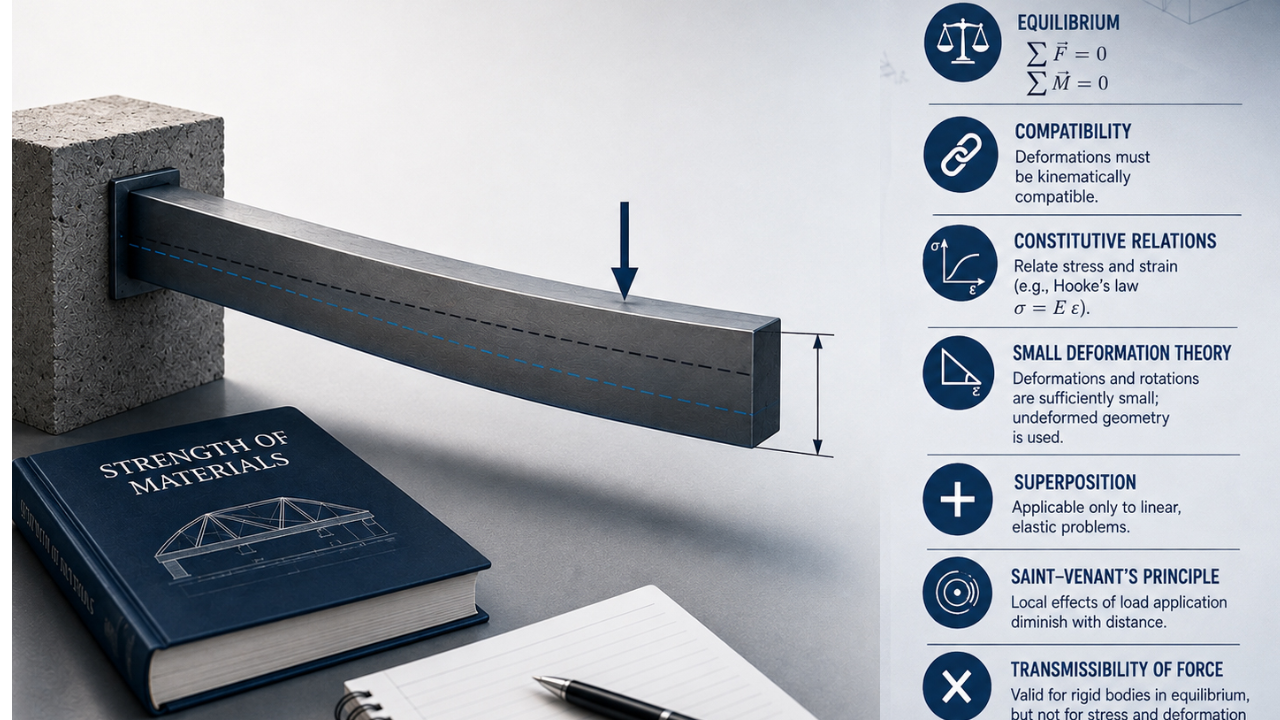
1. Equilibrium Principle
The Equilibrium Principle is the fundamental law of mechanics that must be satisfied by every structural element. It states that for any body at rest, the vector sum of all external forces and moments acting on it must equal zero. In three-dimensional space, this requires satisfying six equations of equilibrium:
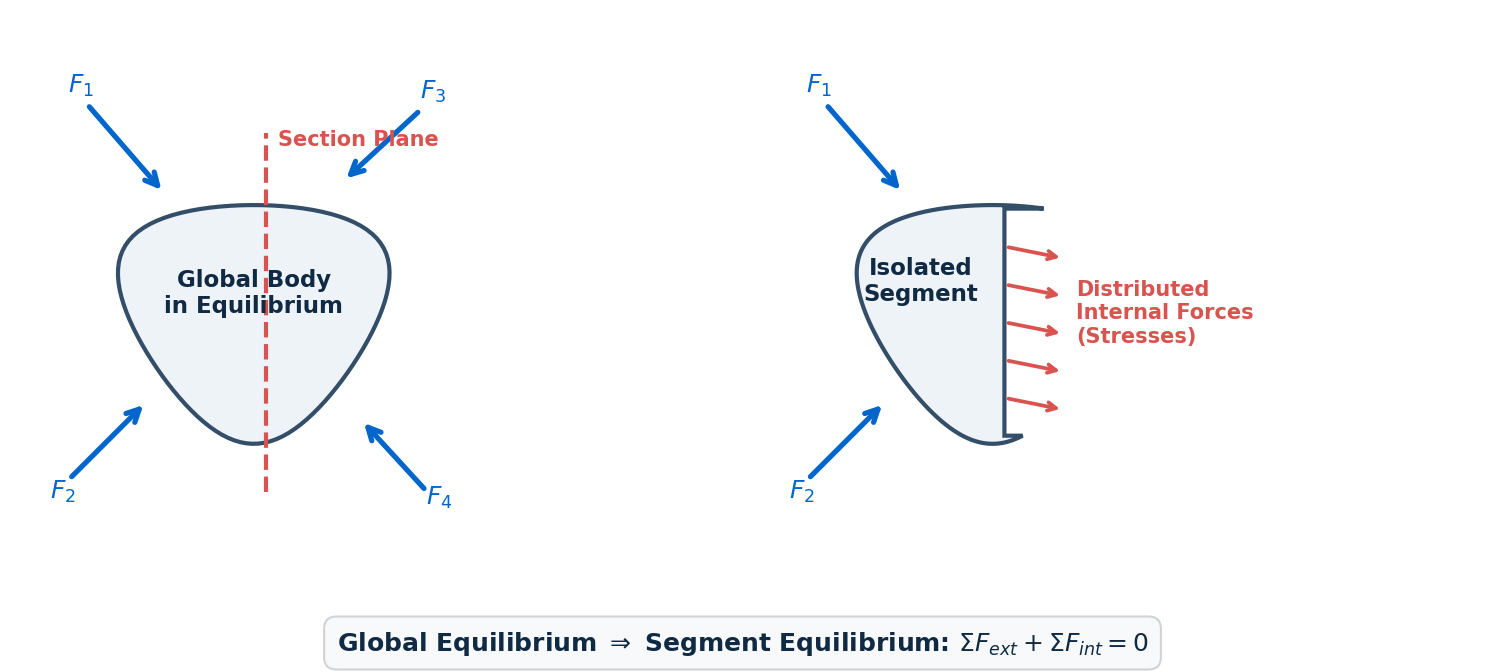
In Mechanics of Materials, we apply the Method of Sections to extend this principle internally. When a body is in global equilibrium, any isolated segment of that body must also satisfy these same equilibrium equations. The external loads on the segment are balanced by the distribution of internal forces (stresses) developed across the sectioned area.
2. Compatibility Principle
While equilibrium equations relate external loads to internal forces, they are often insufficient
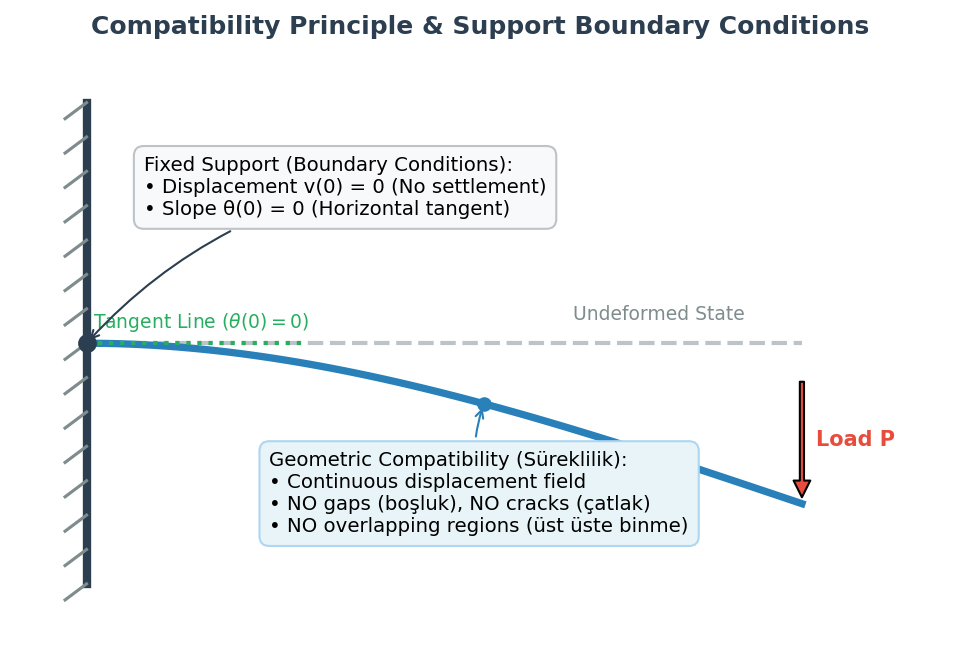
to solve structures that are statically indeterminate. To overcome this, we apply the Compatibility Principle (also known as the geometry of deformation). This principle asserts that the deformations of a structure must be geometrically continuous and compatible with its boundary conditions and physical constraints.
Under external loading, the material must deform without forming gaps, cracks, or overlapping regions. The displacement of adjacent points must be continuous, and the strain field must satisfy specific compatibility equations. For example, at a fixed support, both the displacement and the slope of a beam must remain zero, establishing the necessary boundary conditions for solving deformation equations.
3. Constitutive Relations
To connect the forces (equilibrium) and the deformations (compatibility), we require the physical laws governing material behavior. These mathematical formulations are known as Constitutive Relations. They describe how a specific material responds mechanically when subjected to stress.
The most widely used constitutive relation in classical engineering is Hooke's Law, which establishes a linear relationship between stress and strain. More complex constitutive models exist to describe elastoplastic, viscoelastic, or orthotropic behaviors. By combining equilibrium, compatibility, and constitutive equations, we create the three pillars required to solve any deformable body problem.
4. Small Deformation Theory (First-Order Theory)
In classical Mechanics of Materials, we almost universally adopt the Small Deformation Theory (or First-Order Theory). This theory assumes that the displacements, rotations, and strains experienced by a structural member under working loads are extremely small compared to the member's physical dimensions.
Under the small deformation assumption, the trigonometric functions of a rotation angle \(\theta\) (expressed in radians) can be mathematically linearized:
\(\sin \theta \approx \theta, \quad \tan \theta \approx \theta, \quad \cos \theta \approx 1\)
This assumption has two immense advantages for engineering calculations:
- We can write the equations of static equilibrium using the original, undeformed geometry of the structure rather than its deformed shape, avoiding highly complex nonlinear equations.
- We can neglect higher-order terms in strain equations (such as the square of strain values), keeping the kinematic equations linear and straightforward.
5. Principle of Superposition
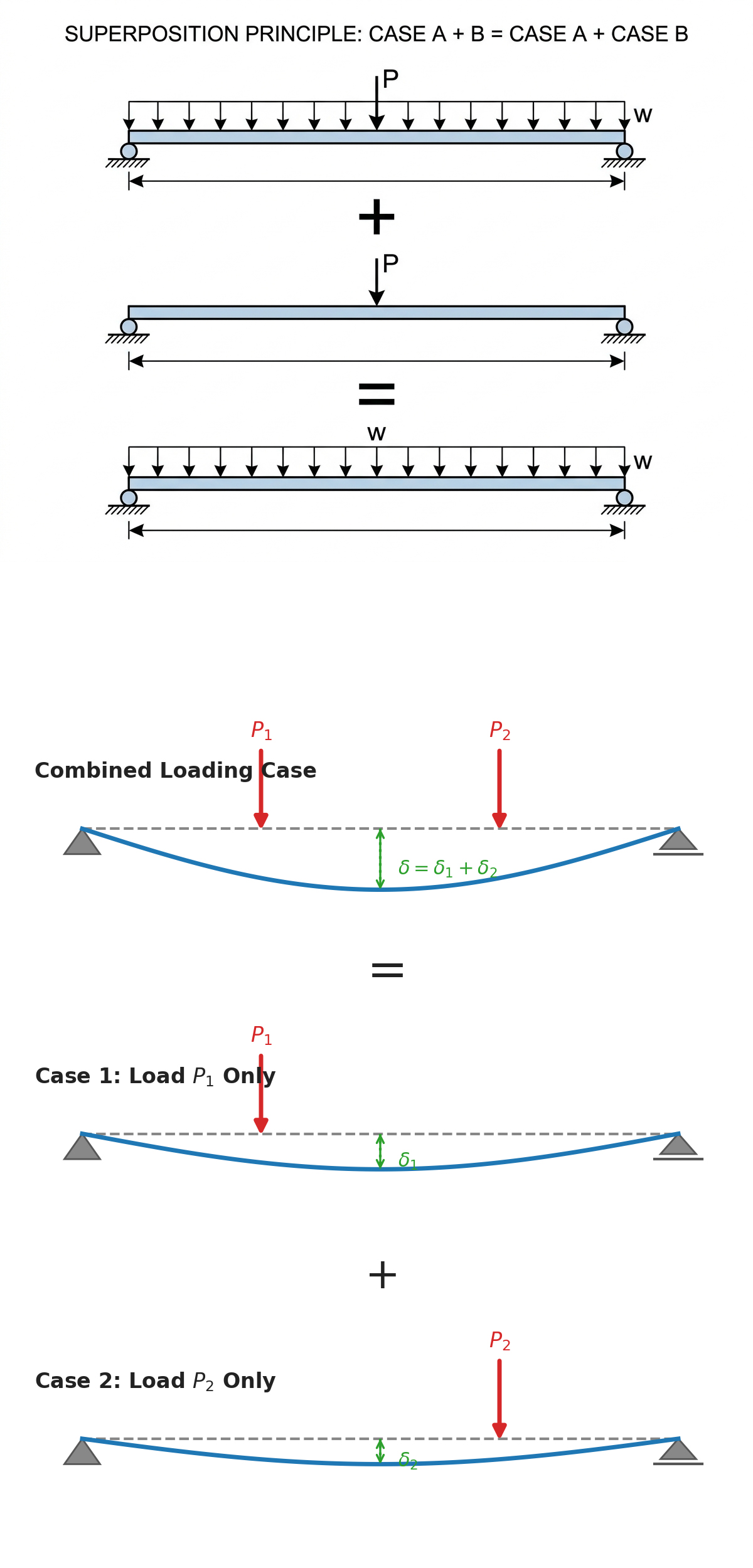
The Principle of Superposition states that the total mechanical response (stress, strain, or displacement) at a specific point in a structure subjected to multiple loads is equal to the algebraic sum of the individual responses caused by each load acting separately.
This principle is extremely powerful because it allows engineers to break down a complex, multi-load problem into a series of simpler, single-load cases. However, superposition is not universally applicable. It is valid only under two strict conditions:
- The material must behave in a linear-elastic manner, meaning stress and strain are directly proportional (Hooke's Law applies).
- The displacements and deformations must be extremely small, so that the application of one load does not significantly alter the geometry or the action of another load.
6. Saint-Venant's Principle
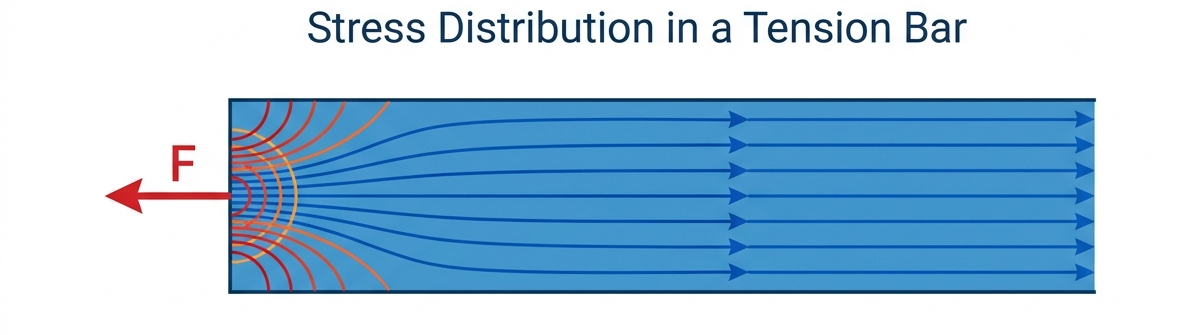
Formulated by the French mathematician Barré de Saint-Venant in 1855, Saint-Venant's Principle states that the specific manner in which a load is applied to a body affects the stress distribution only in the immediate vicinity of the load application region.
At a distance equal to or greater than the largest dimension of the loaded cross-section, the localized stress and strain distributions become practically independent of the actual physical distribution of the load. At this sufficient distance, the stress is uniform and depends only on the static resultant (magnitude and direction) of the applied force system.
This principle justifies the use of simplified normal stress formulas (\(\sigma = P/A\)) throughout a member, ignoring localized stress concentrations at supports, holes, or points of application, provided we are sufficiently far from those discontinuities.
7. Principle of Transmissibility of a Force
In Statics (rigid-body mechanics), the Principle of Transmissibility is a fundamental axiom. It states that a force may be applied at any point along its line of action without altering the external reaction forces or the global equilibrium of the body.
While transmissibility remains valid for calculating external reactions in deformable bodies, it is strictly invalid when analyzing internal stresses, strains, and deformations. Moving a force along its line of action fundamentally alters the localized internal stress state of the member.
For example, if a rod is subjected to two equal and opposite outward forces at its ends, the entire length of the rod is under tensile stress and experiences elongation. If those same forces are moved along their line of action to push inward at the center, the rod experiences compression and shortening. Thus, the exact point of force application is critical when determining material safety and structural deformation.